
No. 03Craft18 min read
The Creative Act: A Way of Being
What Rick Rubin's book gets right about making things: the real work starts long before the work, in how you pay attention.
·
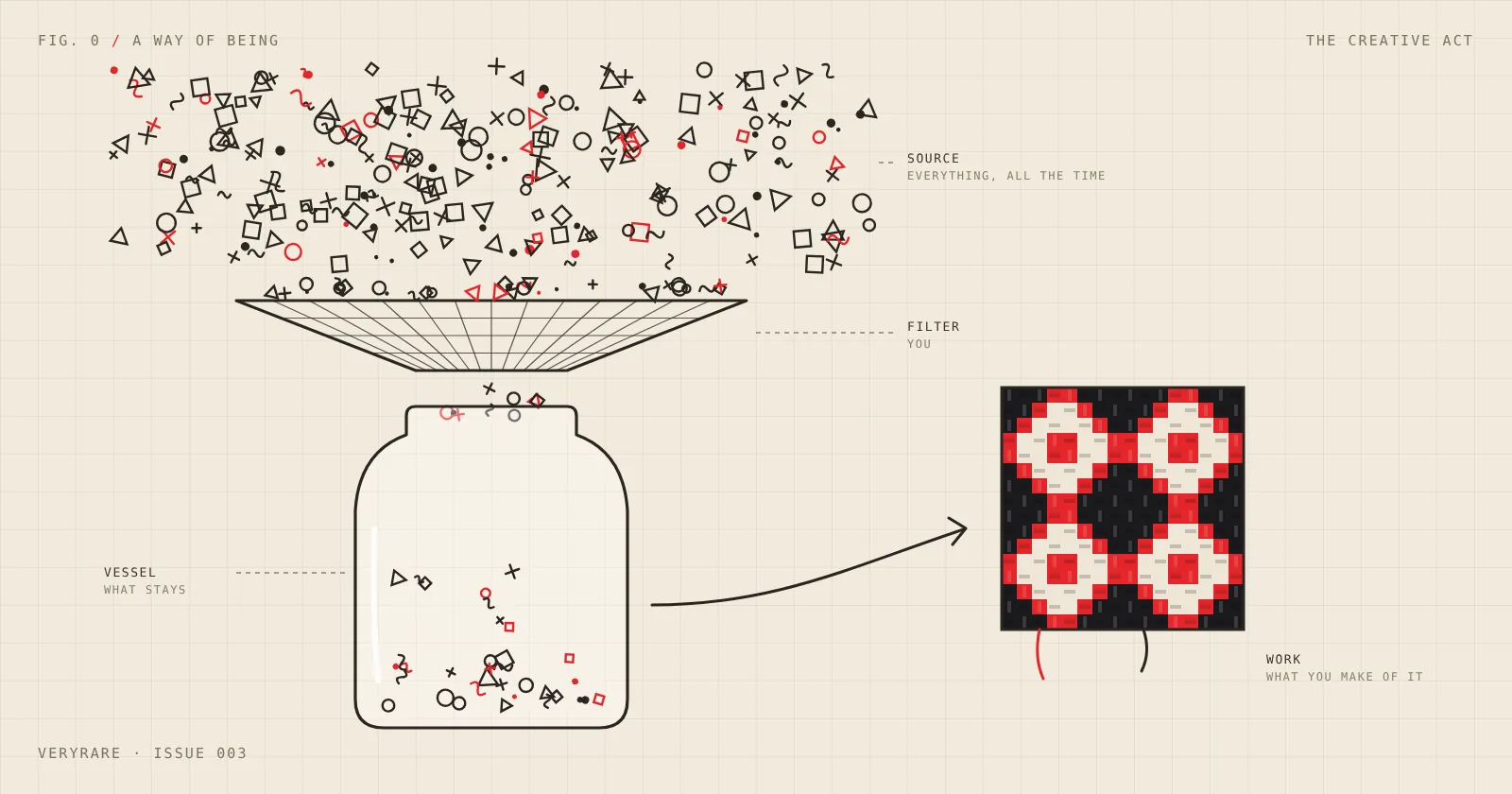
There’s a lie built into the way we talk about making things. We say the work starts when the tools come out: the painter at the canvas, the writer at the blank page, the designer pushing pixels around. Everything before that gets filed as life getting in the way.
Rick Rubin thinks it’s the other way around.
Quick context, in case the name only rings a bell. Rubin started Def Jam in his NYU dorm room in 1984, at 21. The back cover of LL Cool J’s debut album, Radio, doesn’t say “produced by.” It says “reduced by Rick Rubin.” Since then he’s made records with the Beastie Boys, Slayer, Johnny Cash, the Red Hot Chili Peppers, Adele, Jay-Z and Kanye West, among a lot of others. When Anderson Cooper asked him on 60 Minutes in 2023 whether he knew how to work a soundboard, he said: “I have no technical ability. And I know nothing about music.” What he gets paid for, he explained, is the confidence he has in his taste and in his ability to say what he feels.
That same month he put out The Creative Act: A Way of Being, written with Neil Strauss. It went to No. 1 on the New York Times list, and it reads less like a manual than a stack of notes: 78 short sections, with one-line thoughts floating between them. It opens with a line from the painter Robert Henri’s 1923 book The Art Spirit. The object isn’t to make art, Henri wrote, but “to be in that wonderful state which makes art inevitable.”
Rubin’s own version is blunter: “The real work of the artist is a way of being in the world.”
So that’s the bet. The work starts before the work, in what you notice, what you keep, what you cut and when you let go. Below are Rubin’s ideas, some science and history he doesn’t get into, eight things to click on, and at the end, what all of it means for running a clothing brand that wants to stay weird.
The velvet rope
We keep creativity behind a velvet rope. Artists have galleries, musicians have records, writers have books, and everyone else watches.
Rubin’s first move is to take the rope down. To him, creating just means bringing something into the world that wasn’t there before, and he counts small stuff: a conversation, a new route home, the way you set up a room. None of it needs to be recorded, sold or put behind glass. Underneath is a bigger claim. Your senses take in far more than you can handle, and your brain builds a world out of the little it keeps. So everyone already does the basic move of art all day long. We select, combine and decide what matters, mostly on autopilot.
That changes the question. “Am I creative?” turns into “How awake am I while I do the selecting?”
There’s a catch, and it matters later. Success makes this harder. Once you’re known for one thing, people want that thing again. Rubin describes artists who feel chained to an old style because a whole team now depends on it. Beginners get to wander. Everyone else has to fight for it.
The world arrives pre-edited
The most useful model in the book is a little diagram Rubin describes in words: the vessel and the filter. Everything you live through goes into a container inside you. Nothing goes in raw, though. It passes through a filter first, and everyone’s filter is different. Some of the world never makes it through, and what does often comes out bent.
That sounds like poetry. It’s also roughly what psychologists measure.
In 1999, Daniel Simons and Christopher Chabris filmed two teams passing basketballs and asked viewers to count one team’s passes. Partway in, someone strolls right through the game: in some versions a woman with an umbrella, in others a person in a gorilla suit. Across all the versions, 46 percent of viewers never noticed. Even in the most realistic one, about a third missed it. Later studies swapped the players for shapes bouncing around a screen and found that what you notice depends a lot on how much it looks like what you decided to look for. Here’s a small homemade version. Do the task before you read on.
Count the white bounces
Count how many times the white squares hit the edge of the box. Ignore the black ones. It takes 15 seconds and only really works the first time.
The people who missed the gorilla weren’t sloppy. They were concentrating. That’s the uncomfortable part: the filter is what makes focus possible, so you can’t just switch it off. You can know it’s there.
It also explains style better than the word “talent” does. A voice is partly a record of what someone has spent years looking at. If you stare at architecture, film, old prints and the way fabric falls, your choices will carry all of it, even when nothing is quoted directly. That’s why copying a style rarely works. You can borrow somebody’s colors and silhouettes. You can’t download the years of attention that made those choices obvious to them. Rubin is relaxed about imitation for exactly that reason. Copy who you love, he says. You can’t take their point of view anyway, and the gap is where yours shows up. His example is the Beatles playing American rock and roll and coming out sounding like the Beatles.
The warning runs the other way too. A filter that decides what gets in also decides what stays out. Taste hardens into prejudice, experience into certainty. Growing sometimes means adding influences. More often it means noticing the habits that keep some influences from registering at all.
Surround the lightning
Everybody loves the lightning-bolt story: the idea that shows up whole in the shower and makes everything easy. It’s popular because it lets you skip the boring part, which is becoming someone lightning can find.
Rubin’s advice is to stop staring at the bolt and look at the space around it. Before, because lightning only strikes when the conditions are right. After, because the charge fades if you don’t catch it and build with it. And on days when nothing strikes, you show up anyway, like a carpenter.
The first phase of any project, in his telling, is collecting. He calls the starting points seeds: a phrase, a rhythm, a shape, a character, an everyday annoyance that could become a business. You don’t judge them yet. It’s easier to pick the right one out of a hundred, he says, than to judge your only one, because seed number fifty-four only stands out next to the other ninety-nine.
There’s research behind the stepping-away part. In a 2012 study led by Benjamin Baird, people listed unusual uses for everyday objects, then took a 12-minute break. The ones who spent the break on a boring, undemanding task, the kind that lets your mind drift, improved the most when they went back to the same problems. People who rested quietly, did a hard task or got no break didn’t get that bump.
So a walk can be work. It can also just be a walk. You find out which afterward: attention gathers the material, and making is how you see whether anything was in it.
Taste is a kind of memory
We talk about taste like a fixed setting. Good taste, bad taste, not my taste. It works more like memory, built out of everything you’ve ever compared things to.
The cleanest evidence comes from chess. Adriaan de Groot in the 1940s, then William Chase and Herbert Simon in 1973, flashed positions at players for about five seconds and asked them to rebuild the board. Masters rebuilt real game positions almost perfectly. Weaker players got about half a dozen pieces right. Then the researchers scattered the same pieces at random, and the masters’ advantage almost disappeared. They weren’t seeing better. They were recognizing more, in chunks of patterns they’d met thousands of times.
That’s what experience does to perception: it raises the resolution. You can even train it on purpose. In 2001, Yale researchers had first-year medical students study paintings at the Yale Center for British Art and describe what they saw. On a later test of spotting details in photos of patients, their observation skills improved by about 10 percent.
Rubin’s version is to submerge yourself in great work, not to copy it but to calibrate your meter. Read classics for a year instead of the news, he says, and you’ll get much better at recognizing greatness.
Same swatches, more information
Two pieces of the same fabric design. Move along the scale and watch what a trained eye picks up.
Swatch A
Swatch B
Same motif, same colors, probably the same price tag. Most people would call these identical.
Here’s the shadow. The better your taste gets, the faster it says no. Discernment slides into predictability, and whole territories get ruled out because they don’t look like what you already admire. So taste needs two muscles that seem to fight. One says this isn’t good enough. The other says I might not understand this yet. With only the first, you spend your life guarding a point of view you formed years ago. With only the second, you never form one.
The trick you already know
Kids get called more creative than adults. Maybe the precise version is that they haven’t learned to explain away their surprise yet. An adult sees a chair, knows what it’s for, and stops looking at it.
In 1942, the psychologist Abraham Luchins showed how fast a learned solution takes over. He gave people water-jar puzzles: three jars of different sizes, measure out an exact amount. The first few all had the same answer, a three-jar routine. Then came problems with a two-jar shortcut. Most people who had practiced kept using the long routine anyway. Plenty failed outright on a problem only the shortcut could solve, one that people without the practice round mostly found easy. Try it.
The trick you already know
Measure out exactly the amount asked, using the three jars. Each + adds a full jar of water, each − pours a full jar back out. Six problems, no tricks.
Start pouring = 0
In Luchins's classic groups, most people who had practiced the long routine used it again when a two-jar shortcut was sitting right there, and many failed the last problem outright. People who skipped the practice problems mostly saw the shortcut straight away.
The scarier version came in 2008. Merim Bilalić, Peter McLeod and Fernand Gobet showed expert chess players a position with a well-known checkmate in it and a faster one hidden elsewhere. The experts found the familiar mate, then said they were looking for something better. Eye tracking showed their eyes kept drifting back to the squares of the solution they already had. Take the familiar mate off the board and they found the short one.
The Zen teacher Shunryu Suzuki said a beginner’s mind sees many possibilities and an expert’s very few. Rubin’s book is full of ways to fight that: try the opposite of whatever rule you follow, throw out your usual palette before you start, switch to an instrument you barely know. The point is to check whether what you call your style is really just your comfort zone.
One project, four moods
Rubin splits a project into four phases, and the useful bit is that each one wants a different personality.
First come seeds, collected without judgment. Second, experimentation: you play with a seed to see whether it wants to grow, and you don’t edit yet, because cutting too early kills directions you haven’t seen. He draws a nice line here. Knowing what you want and executing it is a craftsman’s job. Starting with a question and following it is an artist’s. Third, crafting, where the romance ends and the bricklaying starts, and where he says people tend to stall. Fourth, completion: the last checks before you let it go. The phases loop, too. You can be deep in crafting and get thrown back into experimenting. That’s normal.
One project, four personalities
Pick a phase to see what it asks of you. Then pick your type and see where you tend to get stuck.
↺ It loops: crafting often kicks you back into experimenting, and finishing back into crafting.
- The job
- Collect starting points without judging them.
- Ask yourself
- What keeps catching my attention?
- The trap
- Crowning a winner on day one.
- The job
- Play. Push each seed in different directions and see what grows.
- Ask yourself
- What else could this become?
- The trap
- Editing before anything has had a chance to sprout.
- The job
- Build. Add, combine, and cut away whatever doesn't feed the core.
- Ask yourself
- What does this piece actually need?
- The trap
- Falling in love with the demo.
- The job
- Final checks. Then let it go.
- Ask yourself
- Is it done, or am I scared?
- The trap
- Polishing forever.
Which are you?
He also sorts people into two types. Experimenters love the early phases and struggle to finish. Finishers race to the end and skip the exploring. His fixes are almost funny in how practical they are. Experimenters should take one small piece all the way to done: two songs out of ten, one drawing, one chapter. Finishers should stay in the play phase longer than feels comfortable.
Two more ideas from this stretch are worth stealing. One is what he calls demo-itis: listen to a rough draft enough times and it hardens into the “real” version in your head, so every change starts to feel like vandalism. Stop replaying the unfinished thing. The other is to stop arguing about ideas in words. When a group debates options out loud, the most persuasive person wins, and that’s how you end up with average work. Build the model, play the take, then decide.
Rules are a material
Every craft comes with rules nobody remembers agreeing to. A hoodie has a kangaroo pocket. A graphic tee puts the graphic on the chest. A brand sticks to its codes. Rubin’s point is that most of these are assumptions dressed up as laws, and the dangerous ones are the ones you can’t see.
He likes rules too, though, as long as they’re temporary and chosen on purpose, like picking a palette for each project. His own examples are good: Georges Perec writing a whole novel without the letter e, Yves Klein limiting himself to one color until his blue became the work, the Dogme 95 filmmakers and their vow of chastity. A few more. Dr. Seuss wrote Green Eggs and Ham because his publisher, Bennett Cerf, bet him $50 he couldn’t write a book using only 50 different words. It came out in 1960, and Seuss said Cerf never paid. Every album and single cover the White Stripes released came in red, white and black. And after surgery in 1941 left Henri Matisse mostly in a bed or a wheelchair, he started cutting shapes out of painted paper, which he called drawing with scissors. The cut-outs became the last great chapter of his career.
Weaving has this built in. A loom doesn’t give you every color in a painting. It gives you a handful of yarns and a grid, and the image has to survive the translation.
Same image, different rules
One drawing, four sets of rules. Switch between them and watch what each rule forces the image to do.
The test is simple. A rule is good when it serves the work and bad when the work starts serving the rule. If you break one, you should be able to say what you got for it. Disobedience on its own isn’t a decision.
Reduced by
If Rubin has a signature move, it’s subtraction. That credit on Radio wasn’t a gag. In the early ’90s, when Johnny Cash was without a record label for the first time in decades, Rubin recorded him mostly in Rubin’s own living room in Los Angeles and in Cash’s cabin in Tennessee, with just his voice and an acoustic guitar. American Recordings came out in 1994 and won the Grammy for best contemporary folk album. Nineteen years later, Kanye West called him in on Yeezus a few weeks before it was due, with about three and a half hours of unfinished music. They spent roughly two weeks cutting it down to ten songs. Kanye’s summary, on BBC Radio 1: “He’s not a producer, he’s a reducer.”
In the book, subtraction turns into a test for essence. Every piece has a core, the thing that makes it what it is. Rubin’s example is a kid’s drawing of a house: erase the window or the door and it’s still a house, but erase the roof and the walls and you’re left with a window and a door floating in space. So keep removing things until the next cut would break it, and stop there. Anything you take out can go back in.
Take it away until it breaks
A cat skull in nine parts. Remove them one at a time. How much can go before it stops being itself?
0 of 9 removed
A cat skull in nine parts. Start taking things away.
When is it done?
There’s a kind of unfinished work that looks very sophisticated. Endless revisions, tiny adjustments, and a maker who can explain in detail why it isn’t ready. Sometimes that’s devotion. Sometimes it’s fear dressed up as devotion.
Perfectionism protects you. If the work never leaves the studio, nobody can misread it, reject it or laugh at it. The imagined masterpiece stays perfect because it never has to deal with gravity, money, deadlines, materials or other people. The real one deals with all of them, and something always gets lost in the translation. That loss is the price of the idea existing outside your head.
Rubin’s answer to “when is it done?” is almost annoying: when you feel it is. He backs it up with practical stuff. Deadlines are fine, just late, once the thing exists and only needs finishing. Show the nearly finished version to a friend, not for notes but to hear it through someone else’s ears. And remember that any single piece is a snapshot of who you were that season, not the full biography.
Paul Valéry wrote in 1933 that a work is never finished, only abandoned: “jamais achevé… mais abandonné.” Navajo weavers have a kinder version. Many bordered rugs carry a ch’ihónít’i, a spirit line: a line of contrasting yarn running from the inner design out through the border, so the weaver’s spirit isn’t trapped in the finished piece. A way out, built into the cloth.
One more revision
A quick sketch of a face. Keep revising it and watch two things: how finished it looks, and how alive it feels.
Revision 0
None of this is permission to be sloppy. It’s permission to tell unfinished from imperfect. Finishing is also what makes the next thing possible. A project that never ends takes up the room of ten projects that might have changed you.
Success speaks a second language
Numbers are everywhere: plays, views, likes, sales. They aren’t meaningless. A business can’t ignore them, and anyone who wants to communicate can’t be fully indifferent to whether the message lands. But numbers only describe what happened after the work met an audience. They say nothing about what happened between you and the work.
Rubin goes further than I’d dare. For him, success is the private moment when you decide the work is ready to go out, before anyone has said a word about it. Everything after depends on timing, distribution, the mood of the culture and what else dropped that week. He even argues that genuinely new work tends to push away as many people as it pulls in.
The classic case: Lou Reed once told Brian Eno that the first Velvet Underground album sold about 30,000 copies in its first five years. Eno’s line, in 1982: “everyone who bought one of those 30,000 copies started a band.”
The trap, which was the whole point of No. 02, is turning that story into an alibi. Most unpopular ideas are just unpopular. Rubin’s advice on feedback sits in the useful middle. Listen to understand the person giving the note, because notes usually say more about the person than about the work. And before you throw one out, check whether it’s pointing at a real problem you hadn’t noticed.
The crowd can tell you something happened. It can’t always tell you what should happen next.
The work makes you back
There’s a quiet reversal hiding in “a way of being.” We picture a stable self making works that express it. But making things changes the maker. A project shows you preferences you didn’t know you had, fears you’d rather not have, and the gap between what you admire and what you can actually pull off. It introduces you to people, materials and questions that reset your taste for the next one. One of Rubin’s in-between lines makes the point that whoever starts a piece today is already someone slightly different tomorrow.
So keep the identity porous. If every new project has to confirm the story you already tell about yourself, the project turns into evidence for a verdict you already reached.
The VERYRARE take: make the world you want to live in
I come at this from a slightly awkward spot. I’m into art, and I also run a business. Businesses have a way of turning every instinct into a demand question. Will it sell? Can we repeat it? What does the market want? Those are fair questions. They’re just not where I want things to start.
The passage in the book that hit me hardest is about a house. Imagine living alone on a mountaintop forever, somewhere nobody will ever visit. You’d still choose the wood, the plates and the pillows with total care, to your own taste and nobody else’s. That, Rubin says, is what great art is: something you make so you can live inside it yourself. Then comes the part that stings if you sell things for a living. If the reason behind a piece is that you don’t love it but somebody else probably will, he says you’ve crossed from art into commerce. He doesn’t hate commerce. He just won’t call it art.
So here’s how I square it. VERYRARE was never about clothing as a product category. It’s about what clothing can carry: the weight of a painting, the framing of a film, the symbolism of a myth, the mood of a moment in history. Our catalog has a Caravaggio Saint Jerome, Botticelli’s Venus, the death of Marat, a giant skeleton from Japanese folklore and Naruto in it. On paper that’s chaos. Run through one point of view, it’s supposed to read as one language.
Weaving is the right picture for that, and not only because we make jacquard. From across the room a tapestry is one image. Up close it’s thousands of crossings, and the image only exists because of how the threads relate. Stacking references isn’t authorship. The goal is to digest them until they stop looking like citations, which takes as much cutting as adding. If every reference shouts, the piece has no voice.
That’s also how I think about the word in our name.
Rare shouldn’t just mean scarce.
Scarcity is easy to fake: make fifty units and call it a drop. Distinction isn’t. The interesting kind of rare is something that could only come out of one specific mix of obsessions, standards, decisions and timing. You can’t get there by restricting supply. You get there by having a point of view worth making real.
Make it scarce, or make it rare
Set how many you make, then add ingredients that only come from one particular head. Watch which meter each control actually moves.
Ingredients
The market rewards consistency, and consistency does build recognition. But it can quietly turn into repetition, where a code that started as a discovery ends up as a template nobody dares to question. I want VERYRARE to be recognizable without being a prison, with an identity that lives deeper than any single motif, fabric or silhouette.
Rubin writes that the business thinks in quarterly earnings while the artist thinks in timeless work. I don’t think they have to be enemies. They just can’t talk at the same time. There’s a time to protect a fragile idea from the spreadsheet, and a time to ask the spreadsheet how that idea survives in the real world. Mix those up and you get either beautiful concepts that never exist or efficient products with nothing to say. The job is to hold that tension without simplifying it.
At its best, a brand is a record of someone who keeps looking and changing, and keeps making their inner world shareable. The products are what that process leaves behind. What I want VERYRARE to mean is a promise to notice what would otherwise get missed, and to give it a form that didn’t exist before.
There’ll always be pressure to go faster: more drops, more content, every passing interest turned into something measurable. It’s easy to mistake that speed for a creative life. But most of the important work happens before there’s anything to show. In how you train your attention. In following an unlikely connection. In admitting your taste isn’t done growing, and in having the nerve to make, cut and finally release something into a world that may or may not get it.
So next time you feel like you’ve got nothing to make, consider that the problem might not be a shortage of ideas. It might be the way you’ve been looking.
Don’t just make more. See more. The making will follow.
— [ARTWEAR c/o Raf Reyes]
Notes & further reading
- Rick Rubin with Neil Strauss, The Creative Act: A Way of Being, Penguin Press, 2023. The opening epigraph is from Robert Henri, The Art Spirit, compiled by Margery Ryerson, J. B. Lippincott, 1923.
- “Rick Rubin”, 60 Minutes, CBS, January 2023 (transcript).
- Rolling Stone, “Dawn of Def Jam: Watch Rick Rubin Return to His NYU Dorm Room”, 2014. LL Cool J, Radio (Def Jam/Columbia, 1985), back-cover credit.
- Johnny Cash, American Recordings (American, 1994). Rolling Stone, “Rick Rubin: Finishing Kanye West’s ‘Yeezus’ Seemed Impossible”, 2013. Kanye West to Zane Lowe, BBC Radio 1, September 2013.
- Daniel J. Simons & Christopher F. Chabris, “Gorillas in our midst”, Perception, 1999. Steven B. Most et al., “How not to be seen”, Psychological Science, 2001.
- Benjamin Baird et al., “Inspired by distraction: mind wandering facilitates creative incubation”, Psychological Science, 2012.
- William G. Chase & Herbert A. Simon, “Perception in chess”, Cognitive Psychology, 1973. Jacqueline C. Dolev, Linda K. Friedlaender & Irwin M. Braverman, “Use of fine art to enhance visual diagnostic skills”, JAMA, 2001.
- Abraham S. Luchins, “Mechanization in problem solving: the effect of Einstellung”, Psychological Monographs, 1942. Merim Bilalić, Peter McLeod & Fernand Gobet, “Why good thoughts block better ones”, Cognition, 2008. Shunryu Suzuki, Zen Mind, Beginner’s Mind, 1970.
- CBC, “Green Eggs and Ham is 60 years old. It started as a $50 bet”, 2020. The White Stripes. Henri Matisse, Jazz, Tériade, 1947.
- Paul Valéry, “Au sujet du Cimetière marin”, La Nouvelle Revue Française, March 1933 (Quote Investigator). On the Navajo spirit line: Jill Ahlberg Yohe, “Situated Flow”, Museum Anthropology Review.
- Brian Eno to Kristine McKenna, Los Angeles Times, May 23, 1982 (Quote Investigator).