No. 02Culture8 min read
First You're Weird. Then You're the Blueprint.
How culture learns to recognize what it once rejected, and why the work can't wait for permission.
·
On April 25, 1874, a critic named Louis Leroy took his readers on a tour of an exhibition in Paris and had a great time hating it.
Thirty artists had set up outside the official Salon, in the photographer Nadar’s old studio on the Boulevard des Capucines. Writing in the satirical paper Le Charivari, Leroy stopped in front of a hazy view of a harbor by Claude Monet, Impression, Sunrise, said it looked less finished than wallpaper, and turned the title into a punchline. He called the whole lot of them “impressionists”. The insult stuck so well it became the name of the movement.
Before something becomes a reference, it’s usually treated like a problem. The clothes look wrong. The visual language doesn’t fit the moodboard. The music won’t sit inside a genre. Everybody asks the same question: who is this even for? It sounds like market research. A lot of the time it’s just the noise people make when they meet something they don’t have a drawer for.
The distance
A few days ago The Mercer Edition put out a short essay on exactly this: You can’t force people to see the vision behind your creative work. Their point is that the more you practice and evolve, the fewer people can follow where you’re going. Audiences give creators a label and expect the work to stay inside it, so when you move, some of them take it personally. Evolution reads as betrayal, when it’s actually the job.
They push it further. Bending over backwards for approval, just so people will finally get it, costs you yourself and the work along with it. And when the vision does land and everyone suddenly calls you a genius, that’s not the finish line, they point out, just the start of the next climb. Then there’s the line I keep rereading:
“Sometimes people don’t understand you because they don’t understand themselves.”
I’d add one thing. An artist and their audience are often looking at the same object from two different points in time. You’ve lived with the idea for two years. They met it four seconds ago. That’s not stupidity on either side. It’s distance.
Same object, different reader
The object below never changes. Keep looking at it and watch the verdict move.
exposures 0
What even is this?
No drawer for it yet. Unfamiliar reads as wrong.
The familiarity tax
We like to think we judge new work on merit alone. We don’t. Everyone carries an invisible filing cabinet of references, memories and scene rules. When something fits a drawer, we can name it. When it doesn’t, we reach for weird, too much, trying too hard.
In 1968 the psychologist Robert Zajonc showed people made-up words and Chinese characters they couldn’t read, some of them once, some up to 25 times. The more often people had seen one, the more they liked it and the more positive they guessed its meaning to be. Nothing about the characters changed, only the exposure. He called it the mere-exposure effect, and a 1989 review of 208 experiments found it holds up.
So the original pays a tax the copy doesn’t. The more unfamiliar its vocabulary, the more explaining it needs, while the derivative shows up pre-translated: its audience already knows how to read it. The derivative is easier to recognize. The original is harder to recognize as original.
Designers have always worked around this. Raymond Loewy, the man behind the Lucky Strike pack and the Exxon logo, had a rule for it: MAYA, for “most advanced yet acceptable”. People want the new, but only as new as they can stand. The catch, which Loewy’s fans tend to skip, is that “acceptable” isn’t fixed. It drifts.
The band moves. Do you?
The red band is what the audience will accept. Drag time forward, with and without evolving.
too weird "Who is this even for?"
The approval trap
Here’s the dangerous part. If every confused reaction becomes a design instruction, the work turns into a negotiation. The strange details get removed. The sharp edges get softer. The idea slides toward what people already know, until the thing that made it yours is the thing you edited out.
Sand it down until everyone gets it
Drag the dial: how much weight do other people's expectations get? Watch what's left of the piece.
Feedback can clarify the work without becoming its author.
But not all criticism is fear of the new. Sometimes the execution genuinely fails. Sometimes the idea doesn’t hold together, or a collaborator sees a weakness you can’t. Being misunderstood is not evidence of genius.
Caravaggio is the best example I know. In 1602 he delivered a Saint Matthew for a chapel altar at San Luigi dei Francesi in Rome: the evangelist as a rough, unlettered man, an angel guiding his hand across the page like a kid learning to write. The church turned it down. So he painted a second version, the one still hanging over that altar, where Matthew writes on his own while the angel counts off points on his fingers. I wouldn’t call that selling out. The second one is still unmistakably Caravaggio. He changed the staging and kept the voice.
And the rejected canvas didn’t need everybody. It needed one person: Vincenzo Giustiniani, a collector who lived across the street, bought it. It later ended up in a Berlin museum and burned in 1945, so today we only know it from black-and-white photos, which says something about how fragile first versions are.
That’s the line that matters, between feedback that helps realize the intention and feedback that replaces it. One makes the work more precise. The other makes it more acceptable. They are not the same operation.
Does this note sharpen the work, or replace it?
Six real-sounding notes. Sort each one, then see our read.
"The print cracks after three washes."
Execution. Fix it and thank them.
"Can you make it more like what's selling right now?"
That's someone else's brief.
"At this weave density the cats disappear. You only see skulls."
The idea has to survive the loom. Keep it, make it readable.
"Nobody's going to get the reference."
Maybe not today. Information, not an instruction.
"The shoulders sit too wide, it hangs wrong."
Fit is part of the work.
"Tone it down so it works for everyone."
Works for everyone usually means belongs to no one.
0 of 6 sorted
A vision doesn’t need everyone to agree with it. It needs enough clarity to survive disagreement, and enough humility to get better without giving up its center.
The language catches up
Then something odd happens. A gesture shows up often enough that it stops looking like an interruption. Someone influential repeats it. Someone else refines it. A publication names it, a brand turns it into a category, and what was impossible to place now looks obvious. The public hasn’t necessarily changed its mind about the original. It has picked up a vocabulary for it.
Half of art history is insults that got promoted. Gothic started as a Renaissance put-down. Baroque comes from a Portuguese word for a misshapen pearl. When Rei Kawakubo brought Comme des Garçons to Paris in 1981, all black and torn, critics called it “Hiroshima chic”. The next year she showed a sweater full of holes and called it lace. In 2017 the Met’s Costume Institute gave her a retrospective.
This is the cruel comedy of influence: the pioneer gets asked to justify the move, and the imitator gets praised for knowing it. Even the famous line about this process went through it. “First they ignore you, then they laugh at you, then they fight you, then you win” is usually credited to Gandhi. The earliest close match anyone has found is a 1918 speech by Nicholas Klein, a union man, to a convention of the Amalgamated Clothing Workers of America. A garment workers’ union. The quote about getting ignored got ignored, then handed to somebody more famous.
Weird, resisted, legible, blueprint
Four times the language caught up. Pick a case.
- 01 · Weird1874Thirty artists show their work outside the official Salon, in the photographer Nadar's old studio on the Boulevard des Capucines.
- 02 · Resisted25 Apr 1874In the satirical paper Le Charivari, Louis Leroy turns the title of Monet's Impression, Sunrise into an insult: impressionists.
- 03 · Legible1874 to 1886The group keeps showing together. Some of them take the name and wear it.
- 04 · BlueprintNowThe insult is the name of the movement.
- 01 · Rejected1602His first Saint Matthew for San Luigi dei Francesi in Rome shows a rough, unlettered saint whose hand an angel guides. The church turns it down.
- 02 · Adapted1602He paints a second version, still on the altar. The rejected one goes to a collector across the street, then to Berlin, where it burns in 1945.
- 03 · Blueprint1600sPainters across Europe copy his light so hard they get a name: the Caravaggisti.
- 04 · Forgotten, then again1951After roughly three centuries of neglect, Roberto Longhi's exhibition in Milan draws more than 400,000 people.
- 01 · Weird1981Rei Kawakubo shows Comme des Garçons in Paris: black, torn, asymmetric.
- 02 · Resisted1981Critics call it "Hiroshima chic" and "post-atomic".
- 03 · Doubled down1982A black sweater full of holes. She calls it lace.
- 04 · Blueprint2017The Met's Costume Institute gives her a retrospective: Art of the In-Between.
- 01 · Weird1800 to 1805Joseph Marie Jacquard, from a Lyon silk-weaving family, builds a loom that reads its pattern from punched cards.
- 02 · Resisted1800sLyon's weavers hate it. Legend has it they threw him in the river.
- 03 · Legible1830s to 1843Charles Babbage borrows the cards for his Analytical Engine. Ada Lovelace says it weaves algebra the way the loom weaves flowers.
- 04 · Blueprint1900sPunched cards run early computers for decades.
Of course, most experiments never turn into movements. Obscurity doesn’t guarantee future recognition, and plenty of weird stays weird for good reason. The point is narrower: recognition is a terrible compass for deciding what deserves to exist now. Caravaggio was copied all over Europe, then mostly forgotten for about three centuries, until a 1951 exhibition in Milan pulled in more than 400,000 people. The paintings didn’t change. The audience did, twice.
Woven weird
At VERYRARE, none of this is abstract to me.
Our signature is jacquard, and jacquard is literally a weird machine that became a blueprint. In the early 1800s Joseph Marie Jacquard, from a family of Lyon silk weavers, built a loom that read its pattern from a chain of punched cards. The city’s weavers hated it; legend has it they threw him in the river. Then Charles Babbage borrowed the punched cards for his Analytical Engine, and in 1843 Ada Lovelace wrote that the engine “weaves algebraical patterns just as the Jacquard-loom weaves flowers and leaves”. Punched cards went on to run computers for decades. Babbage liked to show guests a woven silk portrait of Jacquard, made with 24,000 cards, so fine the Duke of Wellington took it for an engraving.
We weave on that machine’s descendants. Every woven VERYRARE piece is, technically, a program.
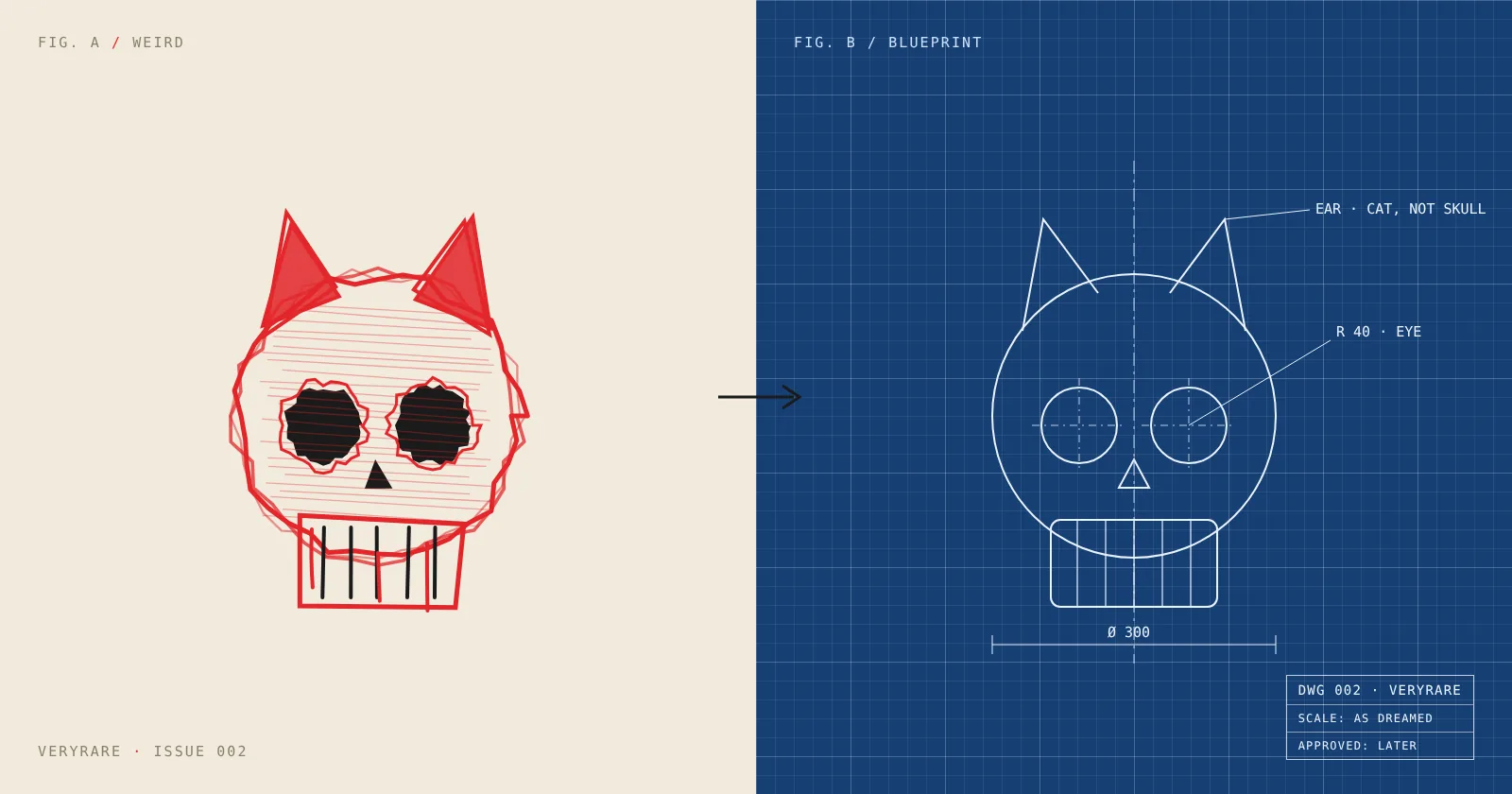
Take the Nozarashi Gosuke hoodie. It comes from an 1840s print by Utagawa Kuniyoshi of a swaggering street hero in a black robe covered in skulls. Look closer and the skulls are made of cats. Kuniyoshi was a devoted cat lover, and it’s his inside joke hiding in a memento mori. At first glance people see a skull hoodie. Then they spot the cats and can’t unsee them. That’s the whole thing in one garment: weird at a glance, obvious once you’ve really looked.
The VERYRARE position
We never set out to make clothes that could be understood entirely by the category they sit in. I wanted to build a world. A garment could carry the density of a painting, the texture of a tapestry, the scale of cinema and the mythology of Japanese prints, and still be something you wear on an ordinary Tuesday.
So when someone asks whether VERYRARE is streetwear, art, fashion or something else, I get the impulse. Categories make things easier to sell, stock, search and explain. But the ambition was never to find the neatest shelf available. It was to make work with enough identity that a shelf might eventually have to be built for it. Artwear isn’t a fancy word for expensive streetwear. It’s the bet that a garment can be a work in its own right.
Even the name gets misread. VERYRARE isn’t only about how many pieces exist. Limited quantities can manufacture scarcity. They can’t manufacture a point of view. The rarer thing is the willingness to make something that doesn’t come pre-approved by the room.
That doesn’t excuse us from craft, business, or our responsibility to the people who wear the work. Quite the opposite. If you ask people to step into your world, you owe them a world that holds together: prints that survive the wash, weaves where the cats stay visible, a fit that sits right. Conviction without execution is just noise.
I’d rather risk someone not getting it today than make something I no longer believe in just so they will. And I’d rather keep moving than spend the next decade reproducing the one idea people finally learned to read. Remember the exposure curve: liking peaks, and with enough repetition it starts to fade. The blueprint becomes the default, and the default becomes wallpaper. Leroy would have enjoyed that.
The most interesting part of becoming a reference isn’t that everyone finally sees what you saw. It’s that by then, you should already be seeing something else.
First you’re weird. Then you’re the blueprint. And if you’re doing it right, you become weird again.
— [ARTWEAR c/o Raf Reyes]
Notes & further reading
- The Mercer Edition, “You can’t force people to see the vision behind your creative work”, Letters From the Front Row, November 6, 2026.
- Louis Leroy, “L’Exposition des impressionnistes”, Le Charivari, April 25, 1874. On the first exhibition: First Impressionist Exhibition.
- Robert B. Zajonc, “Attitudinal effects of mere exposure”, Journal of Personality and Social Psychology, 1968. Robert F. Bornstein, “Exposure and affect: Overview and meta-analysis of research, 1968-1987”, Psychological Bulletin, 1989.
- Raymond Loewy’s MAYA principle, as told in Derek Thompson, Hit Makers (2017).
- Caravaggio, Saint Matthew and the Angel (1602, destroyed 1945) and The Inspiration of Saint Matthew (1602), Contarelli Chapel, San Luigi dei Francesi, Rome.
- Roberto Longhi, Mostra del Caravaggio e dei Caravaggeschi, Palazzo Reale, Milan, 1951.
- Rei Kawakubo/Comme des Garçons: Art of the In-Between, The Metropolitan Museum of Art, 2017.
- Quote Investigator, “First They Ignore You, Then They Laugh at You, Then They Attack You, Then You Win”, 2017.
- History Today, “Jacquard Patents His First Loom”. Ada Lovelace, notes on Babbage’s Analytical Engine, 1843.
- Utagawa Kuniyoshi, Nozarashi Gosuke in a robe covered with skulls made up of cats (1843-1846), Fine Arts Museums of San Francisco.