No. 06Culture11 min read
Catharsis & Terribilità @ VERYRARE
Why some still images refuse to stay still: Aristotle's catharsis, Michelangelo's terribilità, Rodin's Balzac, and what the two words mean for a woven sweater.
·
Near the end of the Louvre’s big spring show, Michel-Ange Rodin. Corps vivants, two giants faced each other. One was a cast of Michelangelo’s Moses: seated, horned, fingers buried in his beard. The other was Rodin’s plaster Balzac, a famous novelist reduced to a towering robe and a lifted head. Neither one moves. Both look like they’re about to.
The wall text that went with them was titled, in three languages, Energy and Terribilità. Rodin’s Balzac, it said, “combines immobility and latent movement in one and the same figure.” I photographed that panel and I’ve been chewing on it ever since.
Because I know that feeling. A man made of marble sits perfectly still and you sense he’s about to rise. A character in an anime stops moving and the whole scene gets more violent. Nothing has happened. That’s exactly why something might.
For a long time the word I reached for, to describe what VERYRARE does, was catharsis. That panel handed me a second one. This piece is about both: where they come from, why they pull in opposite directions, and why I think the best images need the pair.
Catharsis ⇄ the exit
Start with the older word. In the Poetics, Aristotle defines tragedy as the imitation of a serious action that works through pity and fear to bring about a katharsis of those emotions. Then he barely explains it. The word turns up only twice in what survives of the book.
So scholars have argued about it ever since. Part of the context is Plato, who distrusted poetry for stirring up emotions people should keep in check. Aristotle seems to answer him: the emotions tragedy stirs up are doing something useful. Greek doctors used katharsis for a purge, the medical kind. Elsewhere it meant a cleaning, or making something clear. He uses the word again in the Politics, about music, which only makes it murkier. That leaves three main readings today: tragedy purges pity and fear, it purifies them, or it clarifies them so you understand what you felt.
Everyday speech flattened all that into “release”: the cry at the end of a movie, the strange calm after something devastating. The clarification reading is the one I find useful. We walk into a pain we’d avoid in real life, for people who were invented, and we walk out carrying something we didn’t have before. Maybe relief. Maybe the discovery that we could feel that much for someone who doesn’t exist.
A memory can stay mute until a song makes it speak. A fear stays shapeless until a film gives it a face. Art doesn’t necessarily cure the wound. It can make the wound legible.
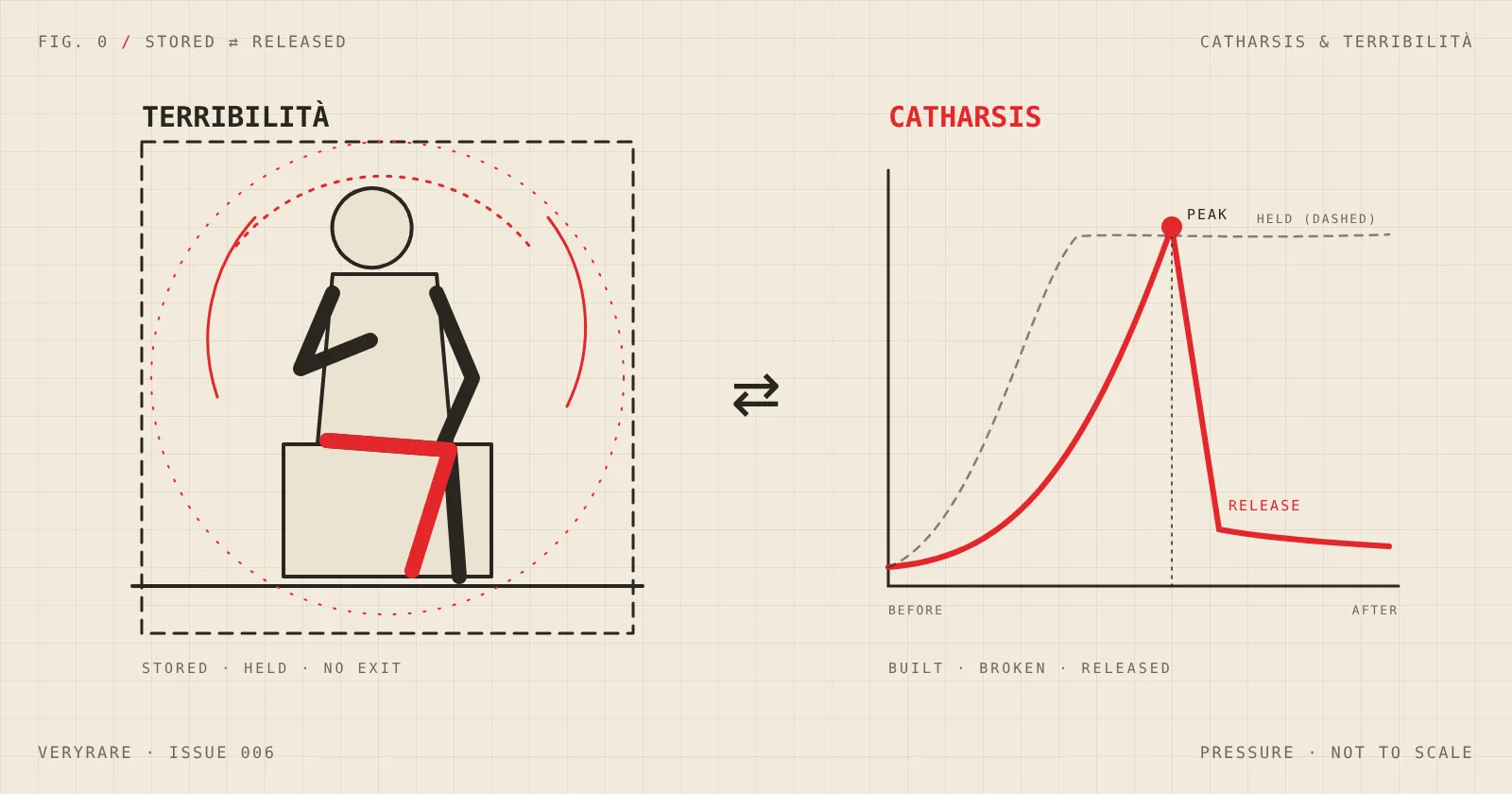
Notice the shape of it, though. Catharsis needs a before and an after. Pressure builds, something breaks, and it comes out. It’s a story with an ending.
Terribilità ⇄ the charge
Now Michelangelo. His contemporaries had a word for the force his figures give off: terribilità. The Louvre panel gives Vasari’s version, roughly a divine and slightly unsettling power to bring the lifeless to life. It isn’t “terrible” the way we use it. Think awe with a little fear in it.
Moses is the textbook case. Michelangelo carved it around 1513 to 1515 for the tomb of Pope Julius II, a project that dragged on for forty years and shrank from more than forty statues to the version you can see in Rome’s San Pietro in Vincoli. Seated, Moses is about seven and a half feet tall. Look at what he’s doing, which is nothing, and how he’s doing it. His head is turned hard to one side. His left leg is drawn back against the seat, the way your leg goes right before you stand. One hand is twisted into his beard. Vasari thought the marble looked more like the work of a brush than a chisel. (The horns, by the way, come from the Latin Bible of the day, where a Hebrew word describing rays of light around Moses’s head had been translated as horns.)
None of that is an action. Each one is the start of an action, and your eye fills in the next second for him. Movement doesn’t require motion.
People have fought over which second it is. Nineteenth-century scholars like Jacob Burckhardt read the moment as the one in Exodus where Moses comes down from Sinai, sees his people worshipping the golden calf, and is about to leap up in anger. Then in 1914 Sigmund Freud published an essay on the statue, anonymously, arguing the opposite: this Moses has already started to rise and is holding himself back, to save the tablets. Read it either way and the pressure is the same. It’s just pointed in or pointed out.
Four small cues, one big future
A seated figure, reduced to blocks. Switch on the cues Michelangelo carved into Moses and watch how much 'about to happen' they add. Then pick whose reading you believe.
So here’s the split. Catharsis is the wound becoming image. Terribilità is the image becoming alive. One is a story that ends in release. The other is pressure with no exit.
Another way to see it: catharsis is horizontal. It moves through time, from an old wound to an image to a release. Terribilità is vertical. It doesn’t go anywhere, it goes up: human, heroic, monstrous, divine. One has narrative depth, the other has symbolic height.
Where does the pressure go?
Pick a word, then drag through time. Catharsis builds and lets go. Terribilità builds and never does.
Balzac in a bathrobe
Rodin knew all of this. He discovered Michelangelo in his thirties and never really recovered. The show opened by making the point in one room: Michelangelo’s Dying Slave and Rebellious Slave, two bodies fighting their own skin, facing Rodin’s Age of Bronze and Adam.
In 1891 the Société des Gens de Lettres, the French writers’ society, then led by Émile Zola, commissioned the 50-year-old sculptor to make a monument to Honoré de Balzac. Rodin took eight years. He made study after study: Balzac naked, Balzac in a monk’s habit. Around 1896 he soaked a real dressing gown in plaster to see how the cloth would hold. By the end the pen, the desk and most of the body were gone. What’s left is a column of robe, a head thrown back, and a figure that seems to advance without taking a step.
The society hated it. When the plaster went on show at the 1898 Salon, critics mocked it, and on May 9 the society formally refused to recognize it, withheld his fee and handed the job to another sculptor. Rodin hauled it home to Meudon. It wasn’t cast in bronze until 1939, twenty-two years after his death. Today it stands at the corner of the boulevard Raspail in Paris, and its refusal to look like Balzac is the whole point. Somewhere in those eight years Rodin stopped sculpting a man and started sculpting a force.
La lutte
The same panel had a phrase I keep coming back to: la représentation de la lutte, the representation of struggle. For Michelangelo, it said, showing a struggle was another way to make visible the tensions running through a body. Rodin picked it up in Je suis belle, where an embrace is staged as a fight.
The struggle doesn’t have to be a literal fight. A shoulder resisting a turn. A hand gripping too hard. A face caught between decision and regret. The conflict leaves the plot and moves into the form. Stone, bronze, drapery: the material is both the prison of the movement and the evidence of it.
That explains an old paradox. The most intense image is rarely the explosion. An explosion announces itself and then it’s over. A figure about to explode recruits you to finish the event, and what you imagine has no ceiling.
Anime knows this better than anyone. Frieza smiling right before he wipes out a planet. Pain floating over a village that’s about to stop existing. Itachi barely moving at all. Every final form in every shōnen series is a body that can barely contain what’s inside it, which is Michelangelo’s whole program with louder hair. The best villains aren’t scary because they move. They’re scary because they don’t need to. That’s terribilità with a soundtrack.
Which frame has the most energy?
Five frames of one shot. Guess first, then step through and compare what you see moving with what you feel coming.
Almost falling
Another panel, another pair of words: équilibre / déséquilibre. For a sculptor who wants to translate vital energy, it said, the way a body moves and unfolds in space is the challenge, and both men pushed right up to the line between balance and imbalance. A third panel described the fall itself as an ambiguous relationship between figures facing the void and the ground that’s supposed to hold them up.
Rodin took it further than Michelangelo ever did. In his hands, as one review of the show put it, the body becomes incomplete and off balance, sometimes just a torso with no head or arms, and somehow more alive for it.
A perfectly stable figure can be satisfying. Threaten its balance and it becomes urgent. Will it recover, collapse, leap? The possibility of falling puts a future inside the image.
And a fall isn’t automatically a defeat. Icarus falls because he flew. A dancer gives her balance away on purpose and catches it again. Walking is controlled falling. The charge lives in the split second when collapse is still negotiable. The show ended on exactly that note, with a Bruce Nauman video of a man alone in his studio, trying to keep his balance on a line that isn’t there.
Lean it until it almost falls
Drag the figure off its center. Watch the red line (its center of gravity) and the tension meter: the charge peaks right before the line leaves the base.
Order strong enough to host chaos
It’s tempting to describe making things as order beating chaos. The artist takes a mess and cleans it up. But the work that stays with you rarely feels pacified. Too much chaos and you can’t read anything. Too much order and there’s nothing left to find.
Think of a Gothic cathedral, where a precise structure makes room for monsters, saints and gargoyles. Or a Baroque painting, all diagonal bodies and theatrical light, held together by brutal compositional discipline. The intensity survives because of the structure. Form lets you get close to the wild thing without turning it into noise.
Here’s how I’d put it: art is order strong enough to host chaos. Bad design is chaos without form. Boring design is order without danger. A storm through a window looks more powerful because there’s a window.
How much chaos can a frame hold?
Turn up the chaos. Then take the frame away and see what's left.
Fair warning, though, because this goes bad fast. Suffering isn’t depth. Aggression isn’t power. Maximalism isn’t meaning. A piece can scream and have nothing to say, and a quiet one can wreck you. Not every encounter with art is cathartic either. Sometimes it disturbs you and offers no release, and sometimes that’s the point. The goal was never to make every image terrifying. It’s to make it feel necessary, as if its form were the only way to hold what it holds.
The VERYRARE take: catharsis becoming terribilità
This is where it gets personal.
I started VERYRARE because the images we grew up with deserved more than the disposable lives culture gave them. A cartoon, a manga panel, a video-game memory, a villain, a childhood obsession: they can live inside you with an intensity that doesn’t care whether a museum signed off. They become a private mythology before you have words for why.
Catharsis felt like the right word for what we do with them. Something that existed as memory or obsession becomes visible and wearable. But on its own the word makes it sound finished, as if turning a feeling into an image heals it. It doesn’t. And it gets soft. Every brand can say a collection is about release or healing. Terribilità gives it teeth. It keeps catharsis from turning into therapy-core.
Catharsis says: “I survived.” Terribilità says: “I survived and became dangerous.”
Catharsis says: “I released the pain.” Terribilità says: “I turned the pain into an idol.”
So that’s the brief. Take a character millions of people recognize. The lazy move is to reproduce it and put a logo next to it. That’s a reference. The better move is to ask what made the character unforgettable. With someone like Itachi, it’s a sacrifice everybody mistook for villainy. Then the composition has to carry that: the gaze, the scale, the stillness, the negative space, even where the image meets a seam. Recognition turns into an encounter.
Jacquard is built for this. The cloth has literal architecture: warp and weft, borders, weight, constraint. It’s the same punched-card logic Joseph Marie Jacquard put on a loom in Lyon two centuries ago, and it carries an image with an almost ancestral seriousness. Put a screen-born image into that structure and you get order strong enough to host the chaos. The tapestry doesn’t grant the image permission. It gives it a different lifespan.
Our Entombment crewneck is the clearest case. Caravaggio painted Christ’s body being laid on a stone slab, one arm hanging, the men carrying him straining against the weight. The man holding the legs, Nicodemus, is often read as having Michelangelo’s face, and Caravaggio borrowed the figure from Michelangelo’s Pietà in Florence. That hanging arm traveled too: Jacques-Louis David borrowed it for The Death of Marat, which is also in our catalog. Grief and gravity in one frame: the catharsis and the charge. Woven, it hangs on a body that moves.
I think of the result as a secular relic, an object that carries memory, contact and belief. But a garment isn’t finished when I design it. The person wearing it brings their own mythology. Some pieces lean cathartic: grief, nostalgia, broken innocence. Some lean terribilità: gods, monsters, final forms. The strongest sit in the overlap, a wounded thing becoming divine through pressure. So before a piece leaves the studio, it has to answer two questions. Where’s the catharsis: is there a feeling worth giving form to? And where’s the terribilità: does this object have presence, or just decoration?
Two questions before a piece leaves the studio
Answer both for a design you love (or one you made). Tap the switches or a square of the grid.
Is there a feeling worth giving form to?
Does the object have presence, or just decoration?
Underneath both sits what I call controlled collapse. How do you make an image feel close to coming apart without losing it? How do you use a beautiful material without sanding down an ugly feeling? How does a sweater imply movement while it hangs on a chair? There’s no formula. Sometimes more detail supplies the force. Sometimes you delete everything but a face.
VERYRARE is the art of turning chaos into form without killing the chaos. Every piece should be a frozen eruption: still, but alive. Beautiful, but a little dangerous. Wearable, and almost sacred.
Catharsis gives the wound a voice. Terribilità gives it a body.
And somehow, it still looks ready to move.
— [ARTWEAR c/o Raf Reyes]
Notes & further reading
- Musée du Louvre with the Musée Rodin, Michel-Ange Rodin. Corps vivants, Hall Napoléon, April 15 to July 20, 2026, curated by Marc Bormand and Chloé Ariot. The wall texts quoted and paraphrased here are from the exhibition. Coverage: RTBF, La Libre and Brut, 2026.
- Aristotle, Poetics 6, 1449b. On the word appearing twice and its medical and “clarification” senses, Nickolas Pappas, “Aristotle”; on the Politics passage, Dana LaCourse Munteanu, Tragic Pathos, Cambridge, 2011; on the three readings, Mahesh Ananth, “A Cognitive Interpretation of Aristotle’s Concepts of Catharsis and Tragic Pleasure”.
- Michelangelo, Moses, about 1513 to 1515, San Pietro in Vincoli, Rome: Smarthistory, the V&A on its cast, and the Museo Omero on the turned head and Vasari’s brush-and-chisel line. On Freud’s 1914 essay and the earlier readings, Finestre sull’Arte and the Library of Congress.
- Musée Rodin, “Monument to Balzac”; on the plaster-soaked dressing gown, the Musée Rodin show Corps in-visibles; on the 1898 refusal, Phaidon.
- Caravaggio, The Entombment of Christ, 1603 to 1604, Pinacoteca Vaticana; see Wikipedia’s summary of the Michelangelo connections, and The Art Post Blog on the arm David borrowed for Marat.