No. 08Culture9 min read
The Bootleg Ate the Original
How fashion learned to copy the copiers: from Dapper Dan's Harlem to Gucci's runway, and why the unofficial rap tee often looks more alive than the merch.
·
In May 2017, on the Cruise 2018 runway in Florence, Gucci sent out a mink jacket with huge balloon sleeves covered in its monogram. Soon after, a retired Olympic sprinter named Diane Dixon posted a photo of it next to a photo of herself in 1989, wearing almost the same jacket. Hers was covered in Louis Vuitton monograms. It had been made in Harlem, without anybody’s permission, by Dapper Dan.
There’s a particular kind of T-shirt a corporation would almost never make. The graphic is too big. Five versions of the same face compete for attention, a manga panel bleeds into another panel, there’s a grainy screenshot, a chrome typeface, an explosion and a color that probably shouldn’t be there. It’s excessive, sentimental, borderline ridiculous, and somehow perfect.
It doesn’t summarize a franchise. It captures how someone feels about it. Often the person who made it doesn’t own the character, the photo or the logo. What they own is a way of seeing. That’s where fashion’s relationship with the bootleg gets interesting: the people accused of stealing an image are sometimes the first to find out what it could become. Then the establishment notices, and sells the look back to us.
Before they called it a collaboration
In 1982 Daniel Day opened Dapper Dan’s Boutique on East 125th Street. It was often open 24 hours a day, for clients who kept those hours: gamblers, hustlers, boxers, and then rappers. They wanted luxury translated into their own language, and the houses weren’t offering it. Louis Vuitton and Gucci put their monograms on bags and luggage. Dan put them on bombers, tracksuits and fur-trimmed coats that took up a whole room.
He was separating a symbol from the authority that claimed to own its meaning. The houses didn’t see it that way. In 1988 Mike Tyson got into a street fight with Mitch Green outside the shop wearing a Dapper Dan jacket, and the photos put the boutique on every luxury lawyer’s desk. Raids followed. One of the lawyers working for Fendi was a young Sonia Sotomayor, now a Supreme Court justice. In 1992, after Fendi won its trademark case, the boutique closed for good and Dan went underground, sewing for private clients. By 1999 one of them was Floyd Mayweather.
Twenty-five years later came the Florence jacket. Gucci called it an homage, but only after people pointed out the resemblance. The asymmetry was hard to miss: when Dan remixed a luxury logo, he was an infringer. When a luxury house remixed Dan, it was inspiration.
Then Gucci did something better than apologize. It called him. By the end of 2017 there was a partnership, and in 2018 Dapper Dan of Harlem opened on Lenox Avenue, an appointment-only atelier stocked with Gucci materials and billed as the first luxury-house store in Harlem. A Gucci-Dapper Dan collection followed, and in 2020 Time put him on its list of the 100 most influential people.
He deserved those flowers. But the chronology matters. The establishment didn’t invent that language. It learned to speak it after somebody else had been punished for developing it.
Who owned the logo, and who owned the idea?
Step through Dapper Dan's story. The two bars track who held the legal mark and who held the look, year by year.
The bootlegger wasn’t behind the luxury house. The house was decades behind the bootlegger.
Counterfeit ⇄ bootleg
A counterfeit made to fool buyers is a different cultural object from a visibly reworked unofficial design. Neither is automatically legal. But one wants to disappear into the original, and the other wants to argue with it.
A bootleg can blow a logo up until it’s absurd, splice references that were never supposed to meet, or turn a corporate symbol into a joke, a tribute, a local dialect. It’s collage as criticism, sampling as design, often devotion and defiance at the same time. That’s the paradox of the so-called fake: sometimes it holds a more original idea than the authorized thing. Original means two things, legally authentic and imaginatively new, and they don’t always travel together. Permission tells you who may sell an image. It doesn’t tell you who did something interesting with it.
Disappear, argue, or just take?
Six made-up objects. Sort each one: does it want to pass as the original, argue with it, or take it and add nothing?
The T-shirt the fan actually wanted
Look at the rap tees of the 1980s and 90s: giant portraits, airbrushed glow, overlapping photos, memorial lettering, faces repeated like icons. Many were promo shirts or bootlegs, printed in tiny runs and sold outside shows or on street corners. Their language was closer to a fan’s bedroom wall than to a brand manual. They were designed to be too much: shrine, tabloid cover, mixtape and family album at once.
Hip-hop was under-merchandised early on, and the bootleggers filled the gap. The DJ and collector Ross Schwartzman, known as DJ Ross One, gathered more than 500 of these shirts in his 2015 book Rap Tees, which runs from the first Sugar Hill Gang concert shirts to the street-corner memorial tees for Biggie and Tupac. In 2015 that was niche archive material. A few years later it was the blueprint for half of streetwear, and in 2023 he needed a second volume, with more than 800 shirts running up to 2005.
The London designer Marino Morwood is the clearest heir. He has said the spark was seeing A$AP Bari in wrecked 90s 2Pac and Ice Cube tees and wondering how a black printed shirt could carry that much character. In spring 2016 he started printing 90s-style tees under his own name, a first run of eight. Then Quavo wore his Gucci Mane shirt, and so did A$AP Rocky and Playboi Carti, and the eight became a brand. That same season Supreme put out its own Gucci Mane tee: one big clean photo on white, with the box logo. Both are great. But only one of them looks like it came from somebody’s wall. Morwood later gave Steve Jobs the same treatment, and the result looked less like an Apple keynote than a Master P album cover. That’s the point: the format is the love letter, whoever it’s addressed to.
A company may have the artist’s name on a contract. The fan has the artist in their head all day. Those are different kinds of access.
The approval paradox
Anime makes the tension almost painfully obvious. A series isn’t just a character and a logo. It’s the close-up before a fight, a trembling hand, a ridiculous face, a panel that’s mostly empty space, a frame that lasts half a second and stays with you for years. An unofficial designer can use the whole emotional archive: a manga panel beside a screenshot, a cropped eye as the entire composition. The question in their head is which fragment made them fall for it, and marketing never comes up.
Official work usually runs on different rules. Depending on the deal, you work from approved art, follow a style guide, send designs through rounds of approval and stay inside agreed product categories. Those rules protect the source, and they tend to narrow the experiments. The result can be surreal: a whole universe represented by one tidy character render over a safe logo, while the unofficial shirt looks like somebody actually watched the thing.
Picture two designers with the same reference. One has a brief, an asset library and three rounds of feedback, and every choice has to survive several desks. The other has a laptop, screenshots and nobody to ask. They can make a beautiful mistake at 3 a.m. and print it before they get reasonable. One process is built to reduce risk. The other discovers things by taking it.
Same reference, two processes
Pick a process, then try adding layers to the shirt. Watch what's allowed and how many desks it has to cross.
The unofficial version can feel more alive, and illegality has nothing to do with it. Chance and personal fixation just haven’t been edited out yet.
Bootlegging the bootleg
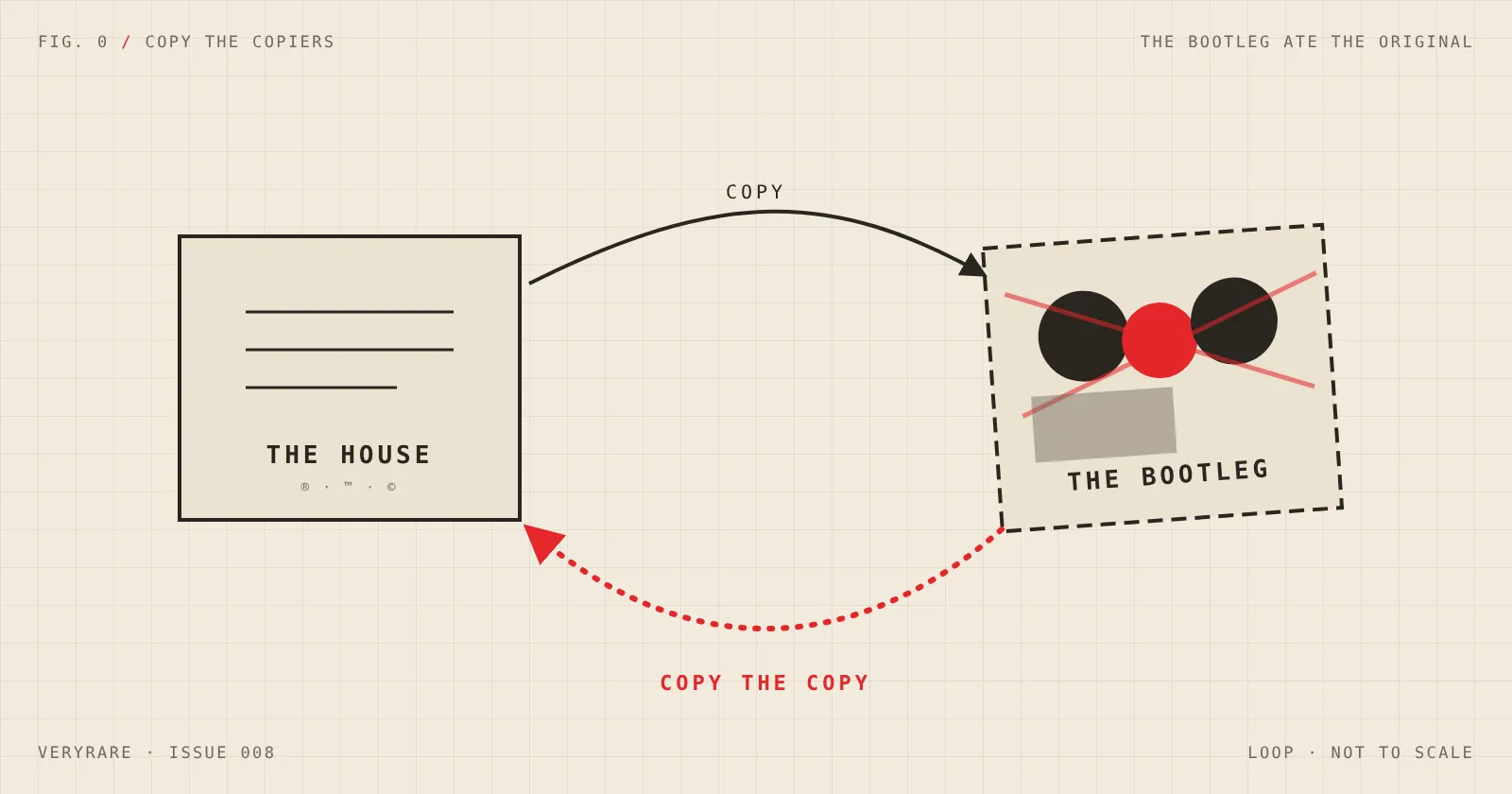
Fashion has a peculiar digestive system. The underground invents a gesture. The establishment dismisses or polices it. The gesture becomes desirable. Then the establishment reproduces it with better distribution, better materials and a press release about its cultural importance. Parking-lot graphics become luxury streetwear. Distorted logos become premium codes. Yesterday’s mistake is recast as intention.
So the question stops being only who owns this image? It becomes: who gets paid when a culture’s invention becomes fashionable, and who gets named? If a house borrows from the edges, the credit can’t stop at a moodboard. It has to travel back to the people who built the language, as money, opportunity or a real collaboration. The difference between exchange and extraction is whether value flows both ways.
Follow a gesture from the street to the capsule
Step through the five stages, then flip the switch at the bottom and run it again. Watch where the money and the credit go.
Not every pirate is a hero
I don’t want to romanticize all of it. Some people take an independent artist’s work, crop the signature, print it cheaply and profit without adding anything. Some counterfeits exist only to fool buyers. Some fan merch pulls money away from the very creators whose worlds made it possible. Calling that rebellion would be lazy. Defending remix culture means defending transformation, and transformation means changing a source’s meaning, audience or possibilities.
And there’s a trap in it. The small designer who asks for the freedom to borrow may one day become the brand that gets borrowed from. The test is whether the principles survive the promotion. Which brings this close to home.
The VERYRARE take: between reverence and disobedience
I run VERYRARE, so I’m not writing this from the bleachers. A lot of what pulls me into making clothes is images that already live in culture: paintings, films, manga, old techniques, things that have passed through a lot of hands before they reach mine. I’ve never believed creativity happens in a vacuum. You obsess, you collect, you pull things apart, you take a wrong turn, and a language starts to appear. Starting from somewhere is normal. Stopping there is the problem.
Working with licensed worlds makes the contradiction real. We make official Naruto Shippuden pieces, and authorization opens doors: legitimate access, better production, and a way for the people behind a story to share in what gets built around it. But approval can also tempt you toward the safest possible reading. You have to fight for ideas without confusing respect for the source with obedience to the most predictable design.
So the goal was never a licensed piece that looks like a bootleg. It’s to carry the energy of bootlegging into a legitimate process: the fearlessness, the obsessive attention, the willingness to collide references, the refusal to accept a character render on a blank shirt as the end of imagination. Jacquard helps. You can’t weave a tidy sticker. A woven panel wants density, layers, a composition that fills the whole surface like a rap tee does.
Our product pages already play with this. They open with “[beyond apparel: this is art]” and close with “[purist style] if you know you know.” That last line is pure bootleg energy: a wink to whoever catches the reference, no license needed to get it.
There’s a difference between using someone’s masterpiece as a shortcut and entering into a conversation with it. The first borrows cultural capital. The second risks changing you, and asks what you can add that wasn’t there before.
Is your licensed piece borrowing, or talking back?
Think of an official design you own or love. Answer four questions and watch the needle.
That means accepting some discomfort. The best composition might be too dense. The best garment might look nothing like what anyone expected. A risk-free process can make perfectly approved work that nobody remembers.
We also owe something to the people at the edges. Fashion loves to discover its future in communities it used to ignore, and it would be very easy, as a growing brand, to celebrate the underground when it’s useful and close the door once we’ve taken the ideas. I don’t want VERYRARE to become that. If the next interesting designer remixes one of our pieces, my first instinct should be curiosity: what did they see in it that we didn’t? That doesn’t erase questions of consent or money. It just refuses to let ownership be the end of the conversation.
The future of fashion doesn’t belong to whoever can prove they got there first. It belongs to people who can take what exists and make us feel it differently.
The bootlegger’s real crime was imagining something the owner hadn’t.
— [ARTWEAR c/o Raf Reyes]
Notes & further reading
- Dapper Dan’s boutique, the raids and the 1992 closure: The Guardian, January 2021; Inside Retail on the 1988 Tyson fight and Sotomayor; WRAL / The New York Times, 2018, on Fendi’s lawyer and the Lenox Avenue space; Gulf News / AP on the underground years.
- The Florence jacket, Diane Dixon’s post and the partnership: Surface, W Magazine and Nylon; Highsnobiety on the first luxury-house store in Harlem.
- DJ Ross One, Rap Tees: A Collection of Hip-Hop T-Shirts 1980-1999, powerHouse Books, November 2015; XXL and DJBooth on the book; Defunkd on Volume 2.
- Marino Morwood’s start: Culted, Pause Complex, and Cult of Mac on the Jobs tee. Supreme’s FW16 Gucci Mane tee: Stadium Goods.
- On bootleg anime merch and creators: Anime Expo, 2021.