No. 05Culture11 min read
Virgil Abloh (and the 3% Rule) & 'Everything I Do Is For The 17-Year-Old Version of Myself'
His 3% rule, "everything's a metaphor" and the line he kept coming back to: "everything I do is for the 17-year-old version of myself".
·
In February 2020, Virgil Abloh posted a photo of himself in Paris. He’s in midair with the Eiffel Tower over his shoulder, a basketball palmed in one raised hand, legs split wide. If you grew up around sneakers you read that shape before you read anything else. It’s the Jumpman pose, the silhouette Nike turned into the Air Jordan logo in 1987.
The caption: “everything’s a metaphor.”
A few days later, his Off-White Air Jordan 5 dropped for NBA All-Star Weekend in Chicago. The first sneaker he ever talked his parents into buying was an Air Jordan 5.
That’s how he worked. A sneaker is a sneaker until somebody puts quotation marks around the word “AIR.” Abloh rarely invented a new object. He moved something, labeled something or put it where it didn’t belong, and the familiar got hard to see the old way.
That one post holds three of his big ideas. The 3% rule: take something everybody knows and change a little of it. The line he kept repeating: everything I do is for the 17-year-old version of myself. And the caption itself. This piece takes them one at a time, with a few things to click, and ends with what they mean for VERYRARE. If you missed the last one, Tourist vs. Purist covers who he was.
Paris, February 2020
The original post, embedded from Abloh's own Instagram account.
The kid who believed the ad
Abloh turned 17 in 1997. He grew up in Rockford, Illinois, in Chicago’s orbit, while Michael Jordan was at the peak of his career. When Rem Koolhaas asked him, for the catalog of his first museum show, which brand he noticed first, Abloh said Nike, because of the role models. Jordan had a superhero effect on a kid from Chicago. “This guy could fly. I believed the campaign.”
So who was that 17-year-old? A Catholic-school kid with Ghanaian parents. His mother was a seamstress and taught him to sew. He skated and DJed (which gave his mother heartburn), and he was already obsessed with the perfect T-shirt. Fashion school wasn’t on the map. He studied civil engineering, then architecture.
He believed it enough to act on it. As a teenager he and his friends sketched their own sneaker ideas and mailed them to Nike, a story Nike now tells itself in its history of The Ten. That first pair, the Air Jordan 5, was Tinker Hatfield’s fighter-jet shoe from 1990.
Thirty years later he was designing it. Talking to Andscape the week it came out, he said Jordan “made you think that you could be Michael Jordan,” and that since basketball wasn’t his avenue, he’d turned that feeling into his own field of work.
Keep that kid in mind. He’s the audience for everything that follows.
For the 17-year-old version of myself
The line most people know is the one his family quoted when they announced his death in November 2021:
“Everything I do is for the 17-year-old version of myself.”
He’d been saying versions of it for years. In 2017 he told W he was always trying to prove to that kid he could do what the kid thought was impossible. Years into Off-White, he told Vestoj he still sometimes felt like the 17-year-old who didn’t believe he could be a designer with a capital D.
Read it quickly and it sounds like nostalgia. Read it slowly and it’s a much harder brief. Seventeen is when you know what you love but not whether the world has room for someone who loves those things. You have taste before you have permission. Obsession before credentials.
So what does designing for a 17-year-old actually involve? His own record points to four habits, and “make it cheap” isn’t one of them.
Put him in the room. For his first Louis Vuitton show in June 2018, Abloh laid a 200-meter rainbow runway through the gardens of the Palais-Royal and invited about a thousand fashion students to line it, each in a T-shirt matching their spot in the gradient. Celebrities sat in the front row. The kids stood right behind them. Afterward he posted a photo of his bow with a short caption: “you can do it too.”
Give away the cheat codes. In 2020 he launched Free Game, a free online course built from the questions he got asked most, like how to name a brand or register a trademark. That July he raised $1 million for a scholarship fund for Black fashion students. When his museum show opened, its curator said Abloh’s goal had been “to create five more Virgil Ablohs.”
Take his taste seriously. He told WWD that a 17-year-old is often more advanced than a 45-year-old, and that this was why Off-White’s design theory broke with tradition.
And don’t dress like him. The curator Michael Darling noted that Abloh saw his Louis Vuitton clothes as closer to his 38-year-old self, while Off-White channeled the 17-year-old. Serving the kid doesn’t mean pretending to be one. He didn’t treat the boy as an embarrassing first draft of the man. He kept him at the table.
If you read the last article, you’ve met this kid already. He’s the tourist: eager, under-informed, standing at the door. What Abloh adds is that the tourist isn’t a stranger. It’s you, a few years back, and you owe him.
Pitch it to 17-year-old you
Same piece, four choices about how it reaches him. Every door starts shut. Open them one at a time and watch the meters and the reply.
Play with it and you’ll notice the price is rarely what loses him. What loses him is a closed door: a reference nobody explains, a process nobody shows. “Look what I did” makes spectators. “You can do it too” makes successors.
The 3% rule
The 3 percent approach was on the list of “cheat codes” he gave at Harvard in 2017: take something that already exists and change it by about 3 percent. In a 2021 essay for Domus he called it a theory worked out in practice and said it was situational. “3% itself is a prototype, just the beginning.” Read it as a permission slip more than a measurement.
The Jordan 5 shows the edit. He kept the 1990 shape, swapped the leather for a semi-translucent upper and gave it a sole that looks yellowed with age. The Chicago-only pair traded “AIR” on the heel for “CHI.” You could still name the shoe from across the street. That’s the point.
The clearest demo is The Ten, the project Nike announced in August 2017: ten classics reworked by Abloh in about ten months. He exposed the foam inside the tongues, moved the Swooshes, printed “AIR” in quotation marks on three of them and “SHOELACES” on the laces, and hung a plastic zip tie off every pair. The silhouettes stayed. A polished product was suddenly showing you its seams.
He’d been running that play since his first brand. In 2012, as Ralph Lauren was closing its Rugby line, he bought up Rugby flannels at about $40 each, screen-printed PYREX and the number 23 on the back, and sold them for around $550. Twenty-three was Jordan’s number in Chicago. The flannel is the 97 percent. The print and the price are the 3.
Here’s the part the quick version skips. Moving a seam is easy. Knowing which seam, and what new thought it starts, is the whole job. A tiny edit without a point of view is just a tiny edit. The rule moves originality from the raw material to the choosing.
A 3 percent edit is small enough to miss. Try it.
Find the edit
Each round, the right drawing is the left one with about 3 percent changed. Tap where. With a keyboard, focus the right drawing, move the red ring with the arrow keys and press Enter.
Find what changed.
Once you’ve seen the 3 percent, you can’t unsee it.
Everything’s a metaphor
Back to the caption. His first museum show was called Figures of Speech, and the catalog describes his work as turning objects, and the people who wear them, into figures of speech. He even wrote the dictionary: his Louis Vuitton show notes came with a glossary, “The Vocabulary According to Virgil Abloh,” where R stood for rainbow. Explaining one collection to WWD, he called an idea in it “a metaphor within my vocabulary system.”
It goes back further than fashion. As a kid, he told Andscape, art didn’t speak to him, but Jordan did, in what he called a metaphoric way. In 2021 he told London College of Fashion students he’d “just metaphorically applied” architecture and engineering to fashion.
Squint and a metaphor is the 3% rule applied to meaning: set a thing everybody knows one notch away from where it belongs. Write “SCULPTURE” on a shopping bag, as he did for IKEA, and not a single fiber changes. The question you ask of it does. Is it a bag? Is it art? Who gets to decide?
Once you look for it, it’s everywhere. For Kanye West’s Yeezus in 2013 he helped make a cover that’s just a clear CD case sealed with a strip of red tape, which he called an “open casket” for the CD. At his museum show, a glowing pink room sat behind a pink curtain printed with the word “BLUE.” He named his label after a color between two others: Off-White, he said, was the gray area between black and white, which is also where the brand sat, between streetwear and luxury. His Louis Vuitton debut borrowed its rainbow from The Wizard of Oz, the story of a kid from the middle of America who follows a colored road to the big city. I don’t think that one needs a footnote.
What it is ⇄ what it says
Pick one of his objects, then run it through the translator: the thing, the one move he made, and what it ends up saying.
- What it is
- The move
- What it says
A metaphor is a door disguised as an object. Not every object hides a message, and not every reading is one he intended. The power is in the gap: what a thing is on one side, what it suggests on the other, and you standing in between.
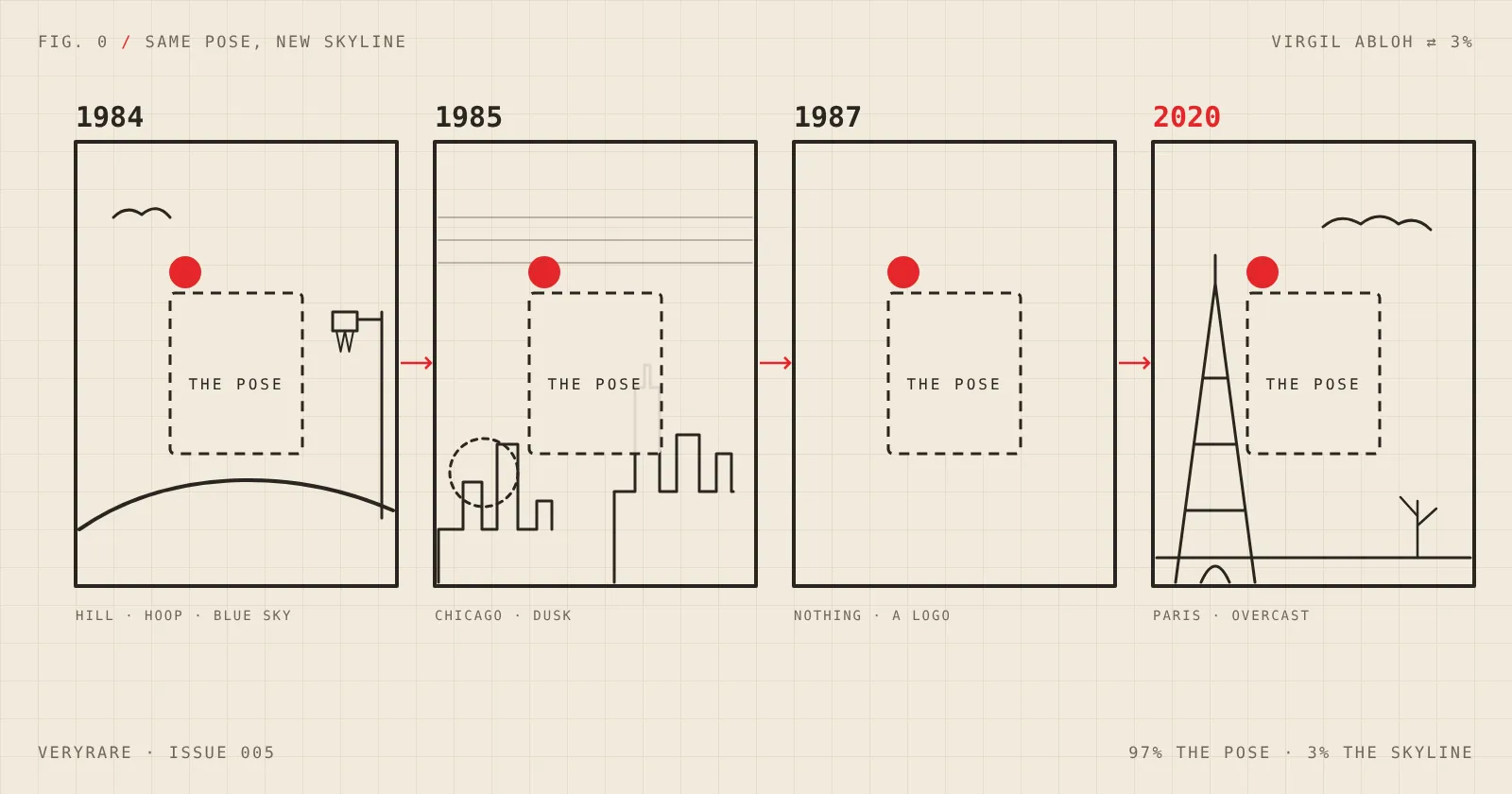
The photo has a backstory too. In 1984 the photographer Jacobus Rentmeester shot a college-age Jordan for Life, leaping toward a hoop in a pose borrowed from ballet. Nike restaged the pose months later with the Chicago skyline behind him and turned the silhouette into a logo. Rentmeester eventually sued and lost: nobody owns a pose, only the choices around it. Thirty-five years later, the kid who believed that ad restaged it once more, with Paris where Chicago used to be.
Four pictures, one jump
Step through 1984 to 2020. The dashed box (the pose) and the red ball never move. Watch what changes in the table, then ask the court.
That’s the whole philosophy in one picture. The pose is the 97 percent. The skyline is the 3. The meaning is the distance between Chicago and Paris, which is also the distance that kid traveled.
Sampling comes with a bill
Fair pushback. If you take something recognizable, change a sliver and sell it as new, where does homage end and lifting begin? In 2013 a menswear site called the Pyrex flannels a markup of about 700 percent. In 2019 The Root asked whether he was a genius or a knock-off king.
He answered both. He had the artist Jim Joe paint the markup line onto a rug for his showroom, so buyers would stand on it. “Who has the last word?” he asked Columbia students later. For the copying charge, he pointed to Duchamp’s readymade and told The New Yorker: “It’s like hip-hop. It’s sampling.”
Good answers, but they don’t settle it. The Ten was made with Nike, not lifted from it. Nike once paid Rentmeester $15,000 for a two-year license on its posters, and a court still ruled the pose itself was free. Law and culture draw the line in different places, and the 3 percent lives right on it.
So here’s the version I’d defend. Culture is cumulative. You need a 97 people already love, a 3 that carries real weight, and the decency to say where the 97 came from.
The VERYRARE take: our 3%
I think about this a lot while building VERYRARE.
Our universe is already full of things we didn’t invent: old paintings, Japanese prints, anime, mythology, tapestry. Abloh’s first brand silkscreened a Caravaggio, The Entombment of Christ, onto tops, and Darling ties it to the art history class that rewired him in college. We weave the same painting into a crewneck. Same 97 percent, four hundred years old, and a different 3.
I don’t believe originality means having no influences. That would make every artist a liar. It means knowing your influences well enough to transform them, so you can point to where you came from without hiding where you’re going. Even this blog’s byline, ARTWEAR c/o Raf Reyes, tips its hat to OFF-WHITE c/o VIRGIL ABLOH.
Picking the 97 is most of the job. It has to be something people feel before they can name it: a face in Caravaggio’s light, a ninja they grew up with, a smile everybody has seen on a mug. Then the 3 has to be ours. A verse turned into “I am VERYRARE.” A painting rebuilt thread by thread in jacquard instead of printed. Those edits decide whether the result is merchandise or artwear. If the 3 could have come from anybody, it isn’t worth the 97 it’s standing on.
We do it to words too. Our newsletters run ordinary words through two letters and make them ours: culture becomes cultVRe, surprise becomes sVRprise, lottery becomes lottVRy. Try one of yours.
Run a word through the machine
Type any word or tap one below. The machine makes the VERYRARE edit and tells you how much of the word it actually changed.
The funny part is that on a word, 3 percent is close to impossible. You’d need a 33-letter word. So the number was never the point. The ratio is: keep almost everything, so the little you change can actually be seen.
As for the 17-year-old, I know which encounter I’m designing for. Somebody sees a four-hundred-year-old painting on a crewneck on the train, looks it up, falls down the hole and comes out knowing who painted it and why. That kid has a wall full of images, a hundred obsessions that supposedly don’t go together, and no official permission. You don’t have to outgrow him to get serious. Maybe growing up is giving him better tools. Every piece has to pass his test. Would he stop scrolling? Would he get it, or at least want to? Would he want to make something after?
And everything’s a metaphor. It’s why our product copy is full of ⇄: Saint Jerome ⇄ Isaiah 41:10, light and shadow ⇄ sorrow meets devotion. Two things facing each other until they mean a third. A hoodie is never just a hoodie. Neither is a basketball, or a skyline, or a teenager in Illinois mailing sketches to a company that doesn’t know he exists yet.
Virgil wasn’t asking us to become another Virgil. Sometimes it starts with three percent. Sometimes it starts at seventeen. It always starts when you decide the meaning is yours to make.
Keep the 97. Change the 3. Do it for the kid.
Everything’s a metaphor. Make yours count.
— [ARTWEAR c/o Raf Reyes]
Notes & further reading
- Aaron Dodson, “Virgil Abloh on the Off-White Air Jordan 5 and his journey collaborating with Nike”, Andscape, February 15, 2020. The post is @virgilabloh on Instagram, February 2020.
- Michael Darling (ed.), Virgil Abloh: “Figures of Speech”, MCA Chicago and Prestel, 2019: Darling’s essay, and Abloh in conversation with Rem Koolhaas and Samir Bantal. London Review of Books, December 2021, on the catalog’s “figures of speech.” WBEZ and Dezeen on the show, June 2019.
- Nike, “The History of Virgil Abloh’s ‘The Ten’” and the announcement, August 21, 2017. Sneaker News on the February 15, 2020 Jordan 5 release.
- Early years: The Week, 2021; Grailed, 2019; Robin Givhan’s Make It Ours, excerpted by Wallpaper, 2025.
- The 17-year-old: his family’s statement, via Harper’s Bazaar Arabia, November 2021; W, May 2017, via Pause; WWD, 2021; Vestoj.
- Dezeen on the 2018 Louis Vuitton debut; Dazed on the “you can do it too” post; Hypebeast on Free Game; the Fashion Scholarship Fund on the “Post-Modern” fund, July 2020.
- Virgil Abloh, “The percentage of creativity is 3%”, Domus 1060, September 2021. The Michigan Daily, December 2017, on the Harvard talk.
- On Pyrex Vision: Complex, 2014, and on his 2017 Columbia lecture and the Jim Joe rug. The Root, 2019. Hypebeast on the 2019 New Yorker profile.
- London College of Fashion, “Virgil Abloh joins LCF for ‘Death of the Designer’”, March 2021. Complex, “A History of Virgil Abloh’s Album Covers”, on Yeezus. Britannica on Off-White’s name.
- Rentmeester v. Nike, Inc., 883 F.3d 1111 (9th Cir. 2018), summarized by Manatt and Sports Business Daily.